Famous for its white chalk cliffs and Second World War beachheads, the northern French region of Normandy is home to numerous towns that positively exude character and charm.
Stretching from the Bay of Mont-Saint-Michel in the west to the lower Seine Valley in the east, the region encompasses a diverse landscape of beaches, chalk cliffs, rolling countryside and historic towns. Our selection of the latter was made using a specific set of criteria, including architectural character and scenic appeal, as well as a mix of beach and inland towns from across Normandy, with each having a population of fewer than 20,000 residents.
Honfleur
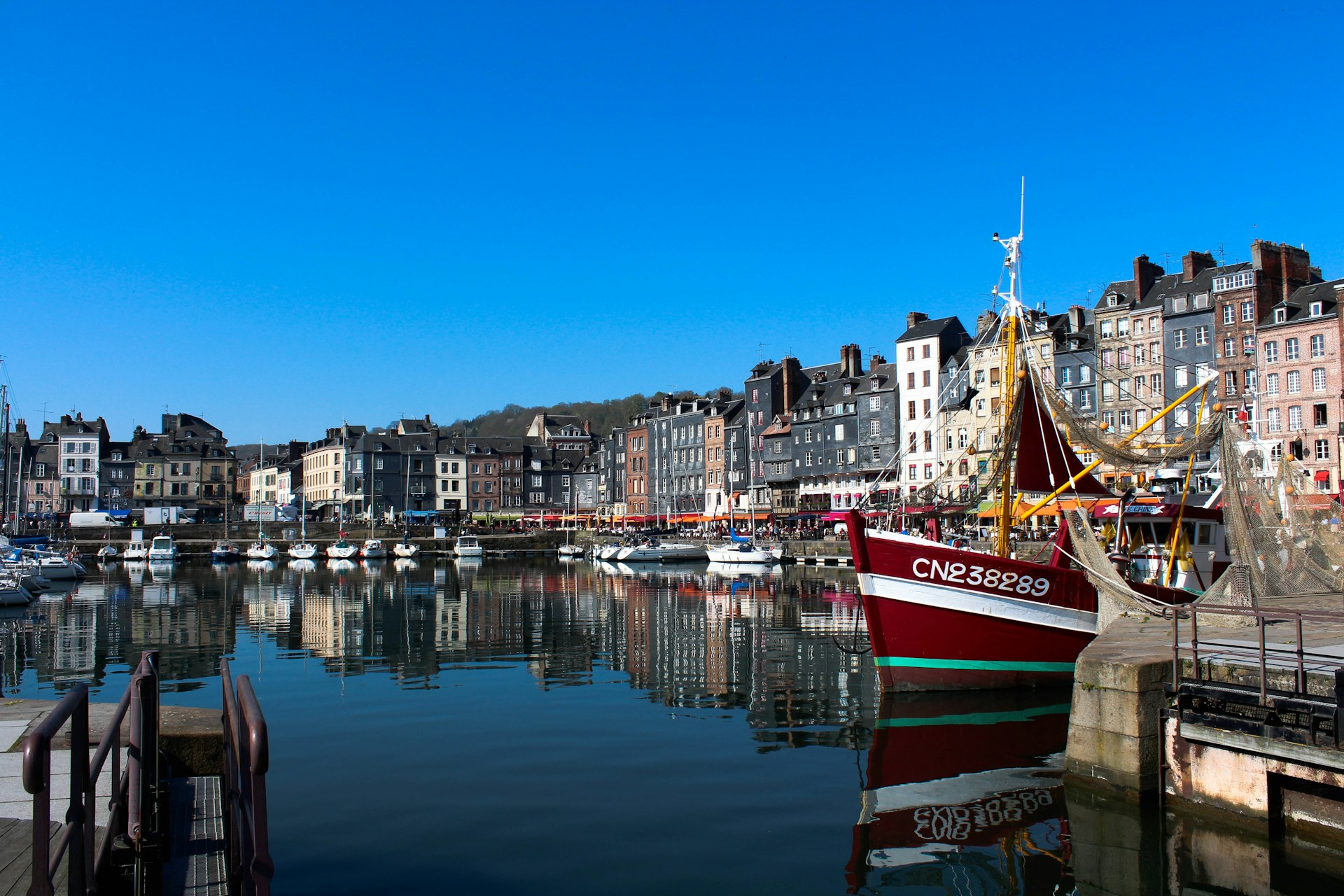
Located on the southern shore of the Seine estuary, picturesque Honfleur exudes character and charm. Its traditional harbour is surrounded by beautiful half-timbered buildings, along with an array of galleries and restaurants. Long associated with the marine trading industry, the town is equally famous for its rich artistic heritage, inspiring world-renowned artists like Eugène Boudin, Claude Monet, and other Impressionists attracted by the distrinctive light here. Venture out of the harbour and visitors will find medieval streets, parks, beaches and the Chapel of Notre-Dame de Grâce, set at the top of the hill where it offers panoramic views.
Étretat

Set along Normandy’s Alabaster Coast, Étretat is a gorgeous seaside town best known for the dramatic chalk cliffs, natural arches and needle-shaped Aiguille that rise above its pebble beach. Once a modest fishing village, it became a fashionable resort during the 19th century, attracting artists including the aforementioned Claude Monet and Eugène Boudin, who immortalised its distinctive coastline in their creative works. Other town highlights include a covered market, clifftop golf course and Asian-inspired Jardins d’Étretat, each serving up dramatic views across the town and bay.
Barfleur
Granite houses, slate roofs and enticing seafood restaurants lend Barfleur the distinctive character of a traditional Norman fishing port. Its history is closely intertwined with England, from the Norman conquest of 1066 to later periods of trade and conflict. Maritime life remains central to the town to this day, with fishing boats unloading their catch along the quays and wild moules de Barfleur harvested just offshore. Visitors can wander among the old fishermen’s cottages, admire the unusual octagonal dome of Saint-Nicolas Church and follow the coastal views towards Gatteville lighthouse, notable for being the second-highest lighthouse anywhere in France.
Bayeux

Home to one of Normandy’s most impressive historic centres, Bayeux is unquestionably best known for its UNESCO-listed tapestry, which vividly recounts the Norman conquest of England in 1066 (see above). The town’s heritage dates all the way back to Roman times, and is evident in its medieval streets, elegant townhouses and majestic Gothic cathedral. Bayeux also played an important role during the Second World War, becoming one of the first French towns liberated in June 1944, and its war museum and British cemetery continue to serve as poignant reminders of that tumultuous time.
Deauville
The upmarket seaside resort of Deauville was originally designed as an elegant escape for wealthy Parisians – and its reputation has held ever since. Dotted with grand hotels, designer boutiques, luxury spas and even its own racecourse, the town continues to attract well-heeled visitors in sizeable numbers. For movie lovers, another major draw is the annual American Film Festival, which is held in the town each September and brings added attention to this small but oh-so-charming corner of Normandy.
Domfront

Half-timbered houses, narrow lanes and hidden courtyards, all dotted throughout a remarkably well-preserved medieval town, lend Domfront an almost fairy-tale look and feel. Loated in the Orne department of southern Normandy, it also enjoys a scenic hilltop position, which originally served a strategic purpose, making it a powerful Anglo-Norman stronghold, but today forms a large part of its appeal as a regional tourism hot-spot. Forest trails and cycle routes add to the town’s allure for walkers and cyclists.
Mortagne-au-Perche

A former provincial capital, Mortagne-au-Perche has an impressive architectural legacy, evidenced by the Flamboyant Gothic Notre-Dame Church, the medieval Saint-Denis Gate and a rare 16th-century cloister. Nestled in the heart of the Perche Regional Natural Park, the many visitors who come here each year do so in large part to enjoy this enduring heritage, as well as the expansive views across the countryside, which are best enjoyed from the formal town hall gardens. There’s also no better way of getting to know Mortagne-au-Perche than by taking in the sights, sounds and aromas of its lively Saturday market.
Falaise
Dominated by a striking stone castle perched on a rocky outcrop, Falaise is forever associated with William the Conqueror, who was born right here in the town back in the 11th century. Much of the present-day fortress was built by his son Henry I and remains a powerful symbol of Norman ducal rule, and giving a visit an almost time-capsule quality. As well as exploring the castle and medieval walls, visitors can also step back in time to learn all about civilian life in Falaise during WWII at the Falaise Memorial, plus making the most of walking, cycling and kayaking opportunities in the surrounding countryside.
Granville

Overlooking a bustling fishing harbour and boasting centuries of seafaring history, this enchanting town on Normandy’s western coast has a true maritime flavour. Historic stone houses and old ramparts occupy a rocky headland, offering picture-postcard views across the Bay of Mont-Saint-Michel and towards the Chausey Islands. Below, beaches and waterfront restaurants amplify the town’s draw as a seaside resort. Granville is also closely associated with Christian Dior, whose clifftop childhood home now houses a museum devoted to the legendary fashion designer.
Bernay

Take a gentle amble through Bernay and traces of the waterways that once powered its mills and workshops are never far from sight. At the town’s heart stands the 11th-century Abbey Church of Notre-Dame, which lays claim to being one of Normandy’s earliest Romanesque churches, while the Charentonne and Cosnier rivers weave past old washhouses and gardens, enhancing the town’s gentle atmosphere. For souvenir and gift-hunting, a myriad of antique shops line Rue Gaston Folloppe.